Terziere Mezule
The Terziere called now Mezule, is the one that expands out of the urban circle towards the Mount, so it is also called 'above'. It finds a hinge along the ancient stretch of the Via Flaminia, actually Via XX Settembre, where there was the Hospital of San Giacomo and rest and refreshment points for travelers.
Beyond the Piazza del Pozzo, another important street was dedicated to the Roman emperor Cocceio Nerva, which leads to the Monastery of Santa Margherita and which stands as an axis from which depart the alleys that go up to the Rocca, ending at the Monastery of Santa Croce rebuilt by Sangallo the Younger and now a noble house. Among the houses there is the memory of the lost churches of San Bartolomeo and Santa Sofia.
Magically, the story of the water of the ancient Formina is expressed in the washhouses of Capretti, in the fountain of Bucci and in the Well of the community, while evoking secret gardens and courts that intersperse houses and palaces, such as those of Mancinelli and De Caldoris, with their arches, from the famous one of via del Monte to the less known one that you meet in via Matteo da Narni.
In the middle the heart of the Terziere, which is the oven of Casa Mancinelli and the headquarters, which was a rest station; the foundations of ancient buildings that open for refreshment, between towers and loggias that you do not expect and views that were loved by plenarists. Upward, the Fortress where was the Monastery of Santa Maria Maddalena and from time immemorial reigns the source of Feronia, whose water was a precious gift.
The Terziere that goes up and looks towards the fortress, just from the fortress resumes a tower that, crenellated and black, stands out on the white background of a shield. This is the crest, and if there is to be a motto, 'Black Tower moves and wins' is the right one.
Terziere Fraporta
The terziere Fraporta, from the flag recognizable for the colours red and blue with white door in red field, develops in the heart of the historical center of Narni. Starting from Porta Ternana, the entrance of the city coming from Terni, climbing along the great Via Flaminia you get to Piazza del Lacus, today Piazza Garibaldi. Turning right you arrive in Piazza dei Priori, passing in front of the Cathedral dedicated to the Patron Saint Giovenale.
In the territory of Terziere Fraporta are the most important monuments of the city. In Piazza dei Priori are located the Palazzo del Podestà, now the administrative seat of the Municipality, and the Palazzo dei Priori, now the seat of the "Corsa all'Anello" Association. Additional squares and palaces are located in various areas of the terziere, including Piazza San Francesco which houses the homonymous Romanesque Church and the nearby Palace. Today it is the official headquarters of the Terziere itself, where the main activities for the Corsa all'Anello take place.
Entering the building, impressive and charming is its internal cloister from which stray the heart of the terziere: the large halls dedicated to catering on the ground floor and the great rooms dedicated to tailoring and custody of clothes on the second floor.
From the inside of the building there is access to an external space that faces west on the Gole del Nera. Here were set up some medieval settings: the "Apothecary" and "L'Orto dei Semplici" in which was built a medieval construction site with working crane.
Along the perimeter of Piazza San Francesco opens the Vicolo dei Mestieri. Here you can enjoy characteristic views and reconstructions of workshops and crafts through the setting up of environments, including the "candle maker", the "carpenter" and the "baker", all operating during the entire period of the celebrations of the Corsa all'Anello.
Entering then in Via del Campanile, one of the most charming streets of the city, you get to the bell tower of the Cathedral, on which you can climb to admire a breathtaking view that winds over the roofs of our beautiful city: the "Superba Narnia".
Terziere Santa Maria
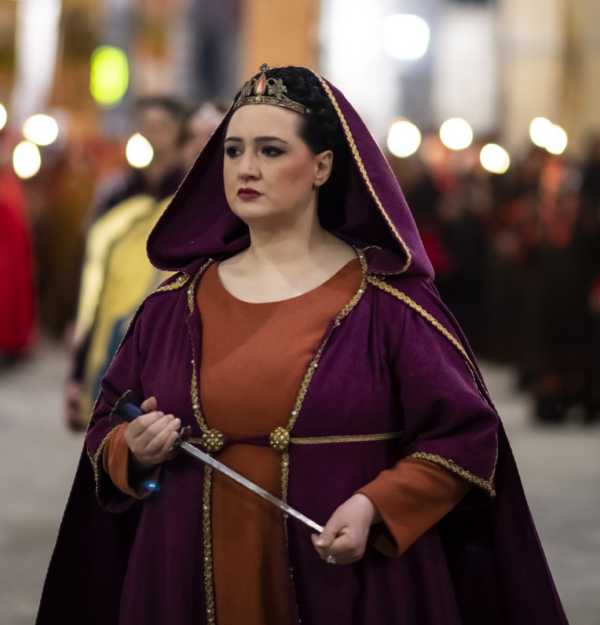
The crest of the Terziere is the stylized facade of the church of Santa Maria Maggiore, known today as San Domenico, on an orange background. The flag is orange and purple.
The Terziere of Santa Maria includes the north-west of the historic center of Narni. It's crossed by the Cardus Maximus of the roman Narnia (today via Mazzini), which overlooks ancient and important buildings.
Entering the Terziere from the main square, the ancient Platea Maior, the church of Santa Maria Impensole, a romanic jewel which can also be visited underground. Then you can find the Torre dei Marzi, where the famous humanist Galeotto Marzio was born and Palazzo Scotti. Finally, the church of Santa Maria Maggiore, later entitled to San Domenico and today concert hall, the ancient cathedral of Narni, replaced by the sanctuary of St. Giovenale.
Going down, there are Palazzo Arca-Marinata, the church of St. Restituta and Palazzo Cardoli, a family that boasted strong ties and notable roles in central Italy. In the background of Piazza Marzio, the building dedicated to the Blessed Lucia, mystic of Narni active at the court of Ferrara. On the other side of Piazza, there is Palazzo Sacripanti, actually headquarter of the university. Along Via Marcellina, you can see architectural evidence of medieval buildings and the Palazzo Capocaccia.
Returning to the city center, in the area where once stood the monastery of St. Bernardo, is attested the settlement of a Jewish community, with leading members of different arts and crafts. In the nearby public gardens, a viewpoint over the Gole del Nera and the Abbey of San Cassiano, as well as the entrance to Narni Sotterranea, open all year round.
The Terziere also has three doors to access the ancient city walls: Porta San Vittore or Porta Nova, where you can see a large wooden door and gallery, rebuilt by the contradaioli of the Terziere; Porta dei Polelli or the Fair, where there was a market; Porta del Vodano, in via Gattamelata, hidden between buildings and gardens.
In that street you can see what was considered to be the birthplace of the great leader Gattamelata, who lived in the city his youth.