It is in the festivities for the Calendimaggio that the origins of the traditional weapons games that were held in May should be sought. In the Celtic countries, the entry of spring was celebrated with tournaments that spread to the southern regions of Europe. It was from the Carolingian period, when the first artificial prairies for feeding horses were sown, that such assemblies took place in May. The meetings of armed men were the occasion of jousts and tournaments that the Church banned several times since the Council of Trento in 1131, denying burial in land consecrated to knights who had lost their lives. May thus became the month of nobles, knights and juvenes, who, trying to identify themselves in the new season, dedicated themselves to hunting and war; it was the month in which the specific rituals of investiture and war took place.
On May 3, the day dedicated to blessed Giovenale, after celebrating the religious ceremony and honoring the patron of the city, the festival left room for equestrian games. The Platea Maior was the invaluable background of those games that are so meticulously described in the City Statutes: the Corsa del Palio and the Corsa all'Anello.
The Vicar had convened the races three days before, once a day, all over the city. The purchase of the Palio (or Bravio) and the Anello was obtained thanks to the 4 gold florins paid to the City by the Jewish community in Narni.
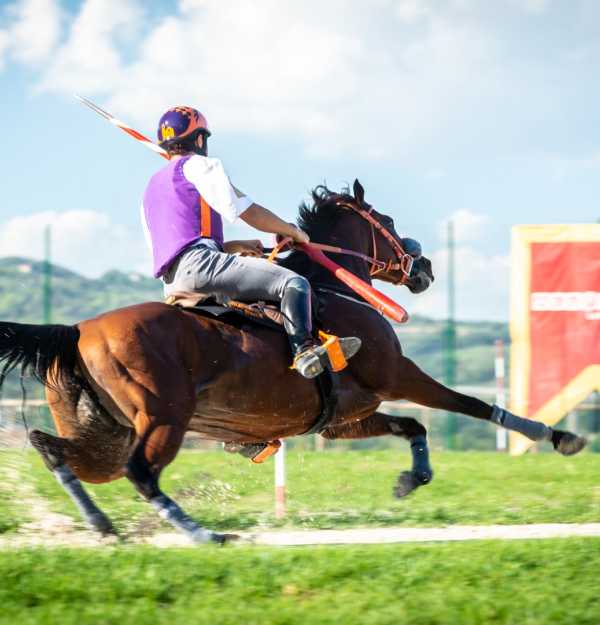
The Palio was a horse race. It took place along the path that connected the church of St. Andrea in Lagia to the "petronum", a place in the Platea Maior where speeches to the people were held. The "milites" and the "equites" could enter to the competition one of their horses, but not a mare or a nag, and a "rigatius" (rider). The silk Palio (or a fine cloth), 9-10 arms long and worth 3 pounds of gold, went to the first knight who came to the "...petronum, ubi est affixa catena...".
If the Corsa del Palio was dedicated exclusively to the rich and noble owners of horses and also open to foreigners, the Corsa all'Anello was reserved only for riders of Narni. Anyone who owned a horse could prepare and participate. The Vicar invited all those who wanted to run, to line up at the corner of the church of St. Salvato, in Piazza dei Priori, towards the Fountain.
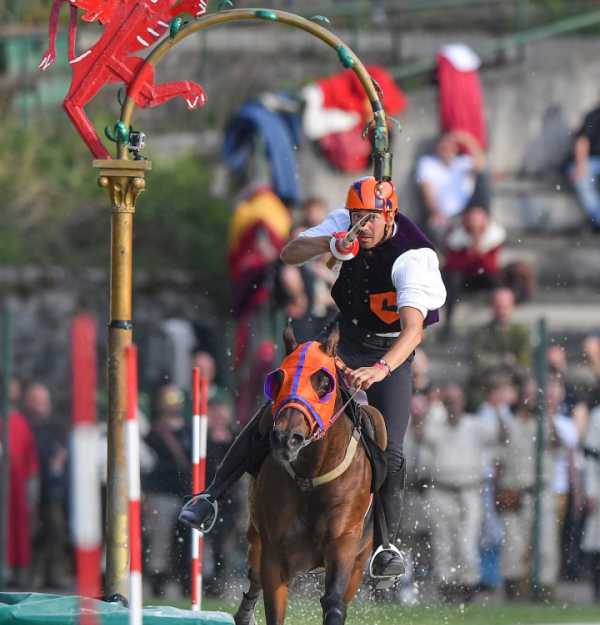
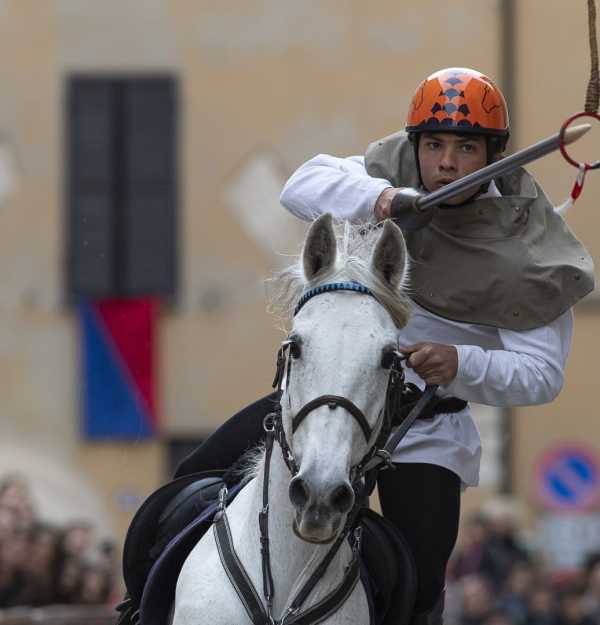
After placing the ring in the proper place, the riders had to go in turn to insert it with the rod or with the flange: the "currente" who first placed his rod in the target according to the judgment of the Vicar, would be the winner of the ring "super aurato" amounting to 100 Cortonesi money. The order of departure of the knights was established according to the belonging to the third Terzieri in which the city and the territory were divided:
"...quod primus currens sit unus ex Potestatibus brigatarum mezulis, secundus currens sit unus ex Potestatibus fraportae, tertius sit unus ex Potestatibus Terzerij Sanctae Mariae".
…quod primus currens sit unus ex Potestatibus brigatarum mezulis, secundus currens sit unus ex Potestatibus fraportae, tertius sit unus ex Potestatibus Terzerij Sanctae Mariae.