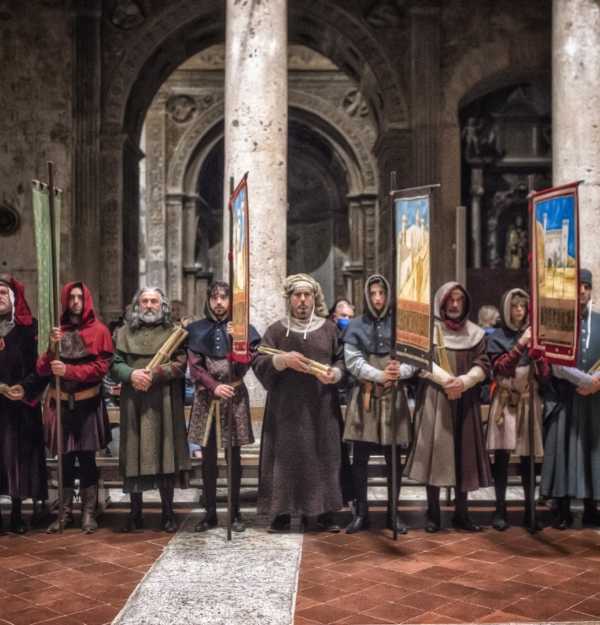
The celebration of the Saint Defensor Civitatis, was lived by the Narni population according to two fundamental rituals: the religious one and the lay one.
The sacredness of the celebration was manifested by some ceremonies, the most important of which was an impressive procession that brought together civil and religious authorities. It took place on the evening of May 2 after sunset and ended with a ceremony of offering candles and dubbing by the city authorities, castles, the arts, parishes and brotherhoods, but also the entire population. The illumination took place under the banner, accompanied by the religious choirs of the confraternities and the sound of musical instruments. The procession ended in the Cathedral dedicated to the Saint, where all the groups were called to make their own offerings.
The Statutes of 1371 mark the time of that ceremonial, which in addition to dressing the meanings of the sacred, contains those political and social elements of coagulation with religion that express the strength characters of the city.
In processions and public events, various are the distinctive meanings that allow you to identify for each subject, for each group, their role. The processional structure, the clothes, the colours, the banners and the flags, perform this task especially in the celebration: each remaining in its place, powerful or miserable, shows itself publicly according to the location that identifies it within its social group.
From the 16th Century, during the Offering of the Candles, the city celebrated its pietas against a murderer, who knelt to the right of the altar, with his hands tied, head shaved and leash around his neck, was beaten three times with a rod in a sign of correction and then freed.
From the medieval Statutes of Narni:
"Item statuimus quod Vicarius dictae civitatis ad honorem e reverentiam ... Beatorum Juvenalis Martiris ... Offeri faciat ... Ecclesia Beati Juvenalis in die Festivitis ipsium dé mense Maij unum pallium sericum ... Pallium prò Ecclesia Beati Juvenalis quatuor florenorum de auro"
"Item statuimus, quod quaelibet Ars Civitatis Narniae debat facere cereum de cera in Festa Beati Juvenalis de mense Maij, ut consuetum est."
Item statuimus, quod quaelibet Ars Civitatis Narniae debat facere cereum de cera in Festa Beati Juvenalis de mense Maij, ut consuetum est.
Medieval Statutes of Narni